Payables Aging (AP)
Unpaid supplier invoices sorted by how many days they are overdue, so you can plan which bills to pay first.
Payables Aging puts every unpaid purchase invoice into an age bucket: not yet due, 1-30, 31-60, 61-90 or more than 90 days overdue. Use it to plan payments and keep good terms with your suppliers.
Before you begin
- Give credit purchase invoices a due date. An invoice without one is aged from its invoice date. See Purchase Invoices.
- Record supplier payments against their invoices, so the unpaid balance on each invoice is right. See Payment Voucher (PV).
- Your role needs permission to view the aging report. Your administrator sets this in Users & Roles.
Where to find it
Open Accounting → Reports → Payables Aging (AP).
Run the report
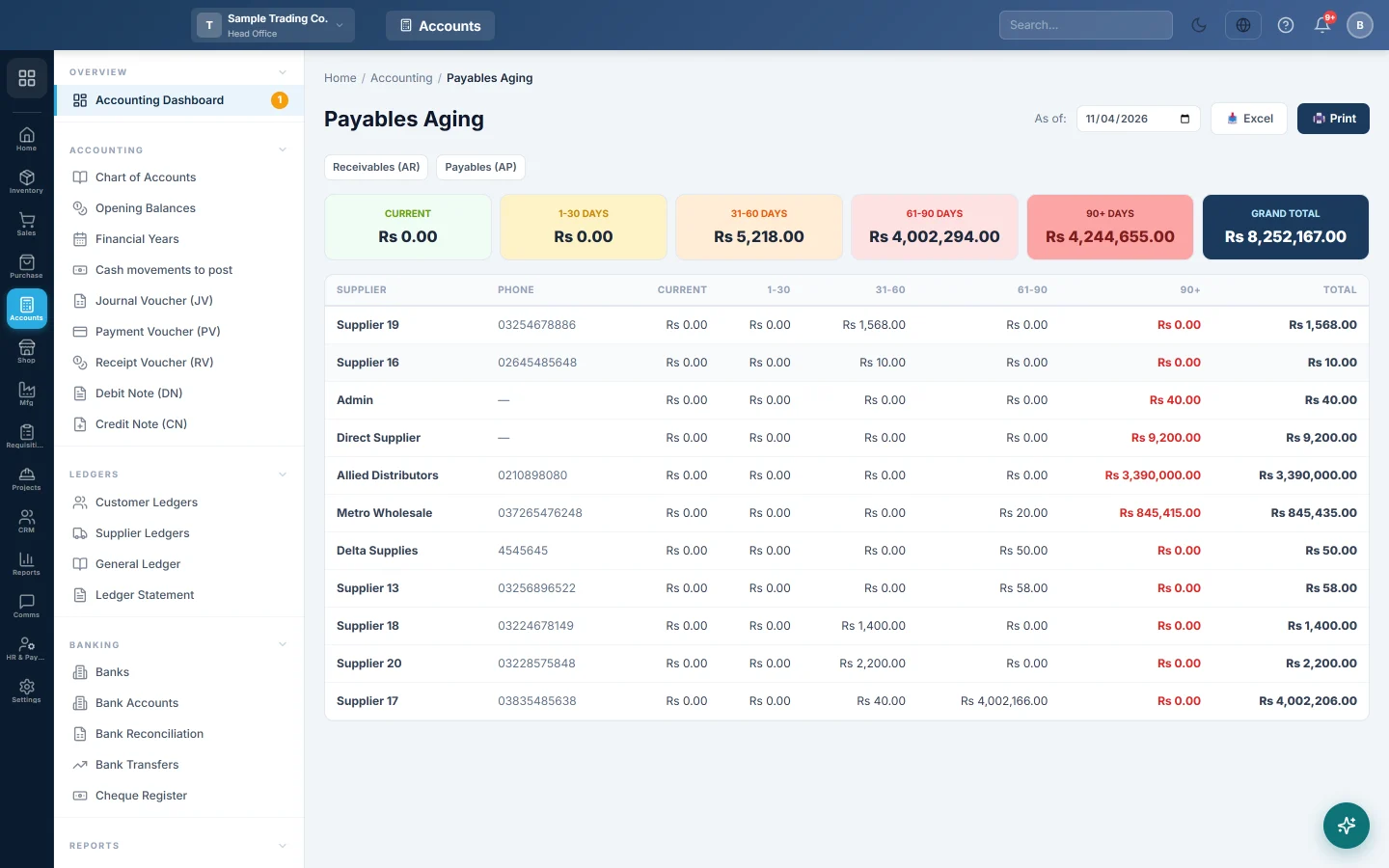
The report opens as of today for the branch shown in the top bar.
- Set As of: to the date you want the ages worked out on.
- Click a supplier's row to see their invoices.
Use Excel or Print to keep a copy. The Receivables (AR) button switches to the Receivables Aging.
Read the report
The six cards at the top add up each bucket for all suppliers: Current, 1-30 days, 31-60 days, 61-90 days, 90+ days and Grand Total.
The table has one row per supplier with the same buckets and a Total. The 90+ amount is shown in red.
Click a row to see each unpaid invoice:
| Column | What it shows |
|---|---|
| Invoice / Plan | The purchase invoice number. |
| Date | The invoice date. |
| Promise Date | The invoice's due date, or — when it has none. |
| Days Overdue | Days from the due date (or the invoice date) to the As of: date. Orange above 30, red above 90. |
| Outstanding | What is still unpaid. |
How invoices are aged
| Days past the due date | Bucket |
|---|---|
| Not yet due, or due today | Current |
| 1 to 30 | 1-30 |
| 31 to 60 | 31-60 |
| 61 to 90 | 61-90 |
| More than 90 | 90+ |
For example, as of 31 July, a bill from City Wholesalers for Rs 25,000 due on 20 July is 11 days overdue and goes into 1-30. A bill of Rs 8,000 due on 15 August is not yet due and goes into Current.
Why figures can look wrong
- Different from the Account Payable register. This report reads unpaid purchase invoices. The Account Payable (AP) register reads the books. Opening balances, journal vouchers and payments not matched to an invoice show in one and not the other.
- A past As of date still shows today's balance. The report picks invoices dated on or before As of:, but uses what is unpaid on them today. Payments made after that date are already taken off.
- Only confirmed invoices count. Draft and cancelled invoices are left out.
- Only your branch. The report shows the branch in the top bar. Switch branch to see another one.
Common questions
Why is a bill I paid still on the list? The payment was not matched to that invoice. Open the payment and pick the invoice on the line. See Payment Voucher (PV) and Payments to Check.
What is "Cash Supplier"? An unpaid purchase invoice with no supplier picked. Each one is listed on its own row.
Can head office see all branches together? No. The report covers one branch at a time, the one in the top bar.
Where do I see the supplier's full history? Open Supplier Ledgers and click the supplier.
谢谢。 如果仍需帮助,请发邮件至 info@eloerp.net。